$CELC: a first-in-class PAM inhibitor with three shots on goal
$CELC · Celcuity Inc · by Thomas Bouman ·
covered since
bullishRating
$165.00Price target · 12M
$90.14Written at
4Notes
Celcuity cracked a cancer target that stumped drugmakers for two decades, and REVTORPYK is now the only approved drug that fully blocks it. The current approval covers about 60% of a second-line breast cancer market Celcuity sizes above $6B, with more still to come.
The Thesis (The Story)
The approval
Celcuity became a commercial-stage company on July 14, when the FDA approved REVTORPYK (gedatolisib) for HR+/HER2-, PIK3CA wild-type advanced breast cancer, meaning patients whose tumor does NOT carry a specific mutation in the PIK3CA gene, after they've already tried at least one hormone-based therapy. Approval came three days early through an FDA fast-track review process, backed by Priority Review and Breakthrough Therapy status, both signals the FDA saw urgency and strong data behind the drug.
The mechanism
What makes this drug different comes down to mechanism. The pathway it targets, called PAM (short for PI3K/AKT/mTOR), is one of the most important cancer growth pathways out there, and drugmakers have tried and failed to properly block it for almost twenty years. The problem was always that blocking one part of the pathway let cancer cells reroute around it, like closing one road but leaving five detours open. REVTORPYK is the first approved drug that blocks all the relevant detours at once, hitting four related PI3K enzymes plus both parts of the mTOR complex in one shot.
The data
The trial data behind the approval backs this up. In the approved patient group, adding REVTORPYK to standard hormone therapy nearly quintupled how long patients went without their cancer progressing (9.3 months versus 2 months for hormone therapy alone), and roughly a third of patients saw their tumors shrink, versus almost none in the comparison group.
The market opportunity
Around 37,000 US patients a year reach this second-line stage of treatment. About 60% of them, like the current label covers, don't have the PIK3CA mutation. The other 40% do, and Celcuity is filing for approval in that group too. Together, management sizes this opportunity at over $6B, and that's before counting first-line use, which is a bigger market again.
What's approved today is the smallest slice of what this drug could become. The mutant-population filing lands this quarter, and a separate trial (VIKTORIA-2) is already testing it as a first-line treatment. If both land, one drug could end up covering nearly the entire second-line population regardless of mutation status, sold by one team, backed by one safety record.
🐂 Bull Case (What has to go right?)
A genuinely new mechanism in a target class nobody else has fully cracked, now backed by an actual FDA approval, not just promising early data
Three separate paths to more revenue from one drug: the current approval, the mutant-population filing due this quarter, and the first-line trial running behind it, plus an early prostate cancer program further out
Covers the full second-line market regardless of mutation status if the mutant filing succeeds, a $6B+ opportunity
The trial data is hard to argue with: nearly a third of patients responded versus roughly 1 in 100 on the old standard of care
An approved drug with a clear mechanism story is a much easier acquisition target for a larger pharma company than something still in trials
🐻 Bear Case (What are the risks?)
Celcuity has exactly one drug. If gedatolisib underperforms commercially, there's no backup product to fall back on
This is the company's first-ever product launch, already delayed slightly by manufacturing, going up against competitors with decades of oncology sales experience
Blocking this pathway on multiple fronts at once means patients need closer monitoring, which could push prescribing toward specialist cancer centers and slow adoption at smaller, community clinics where a lot of patients are actually treated
Drugs in this class have historically been harder for patients to tolerate, so doctors may hesitate regardless of what the approval says
Ramping up a sales and commercial team costs real money, and if the launch is slower than hoped, the company may need to raise more cash, which could dilute existing shareholders
Conclusion
This isn't really "one drug got approved." It's a mechanism that took the industry two decades to properly solve, now proven to work, with a filing this quarter that essentially completes the second-line opportunity and a first-line program still to come. Most of the market's attention right now is on a one-quarter supply delay. The more relevant question is whether one drug can carry three separate indications over time.
The risk here is concentration: one drug, one company, first-ever launch. From here, execution is the whole story.
Update notes & developments
$CELC: Approved, now it has to prove it (launch, mutant label, ESMO)
Update note · · written at $60.30
Celcuity won FDA approval for gedatolisib on 14 July, but the stock is ~33% below our initiation as the launch, tolerability and a sector-wide selloff test the story. The next proof points are ESMO on 24 Oct and the first sales in November.
Company and assets
Celcuity develops gedatolisib (REVTORPYK), an intravenous pan-PI3K/mTOR inhibitor for HR+/HER2- advanced breast cancer. The FDA approved it on 14 July 2026 for the PIK3CA wild-type population, based on the Phase 3 VIKTORIA-1 trial. The PIK3CA-mutant population is the second shot: an sNDA was planned for Q3 2026 and no FDA action date is public yet. A prostate cancer (mCRPC) data update is guided for Q4.
What has happened since I initiated
Approval was the win, the launch was the miss. On 14 July the FDA approved REVTORPYK, but the company said commercial launch would come in late Q3 because the FDA still had to clear a second manufacturing site. The stock fell 17.6% on 15 July to $91.51. Stifel called the guidance "somewhat extended".
The selling did not stop once the delay was priced. The stock is now about 33% below my initiation price and roughly 46% below the $111 close before the launch news. Q2 EPS was -$1.44 against -$1.16 expected, and on 7 October the stock fell another 7.9% with no company news I could find.
Most of this is the tape. Hedge funds are cutting biotech gross exposure, rates are rising (Fed at 3.75 to 4.00%, CPI at 3.7%), and the stock sits below its 50 and 200 day averages. The efficacy and safety data have not changed since I wrote the thesis.
What has changed is what the market demands. With approval done, the risk shifts from regulatory to execution. Until prescription data arrives, the stock leans on the data and the balance sheet.
Thesis
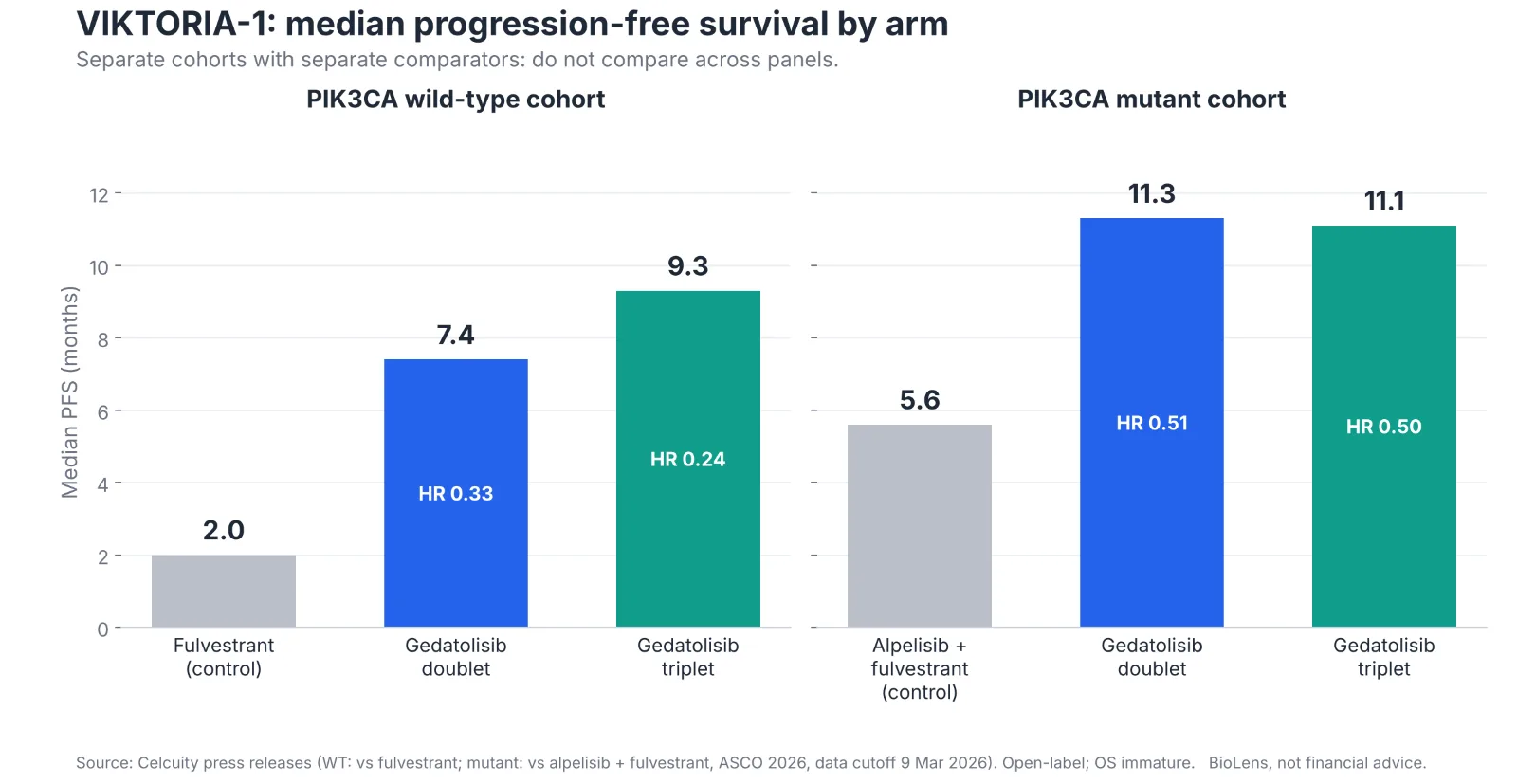
The efficacy is large and consistent. In PIK3CA wild-type patients, median PFS went from 2.0 months on fulvestrant to 7.4 months on the doublet (HR 0.33) and 9.3 months on the triplet (HR 0.24). In the mutant cohort, median PFS went from 5.6 months on alpelisib plus fulvestrant to 11.3 months on the doublet (HR 0.51) and 11.1 months on the triplet (HR 0.50), a halving of the risk of progression or death against the current standard of care. The doublet arm is small (n=52) and its p-value is descriptive. Overall survival is immature and the trial is open-label.
VIKTORIA-1: median PFS (months) per arm, wild-type and mutant cohorts. Source: Celcuity.
VIKTORIA-1 median PFS per arm. Each panel has its own control arm, so the two panels are not comparable with each other.
It is tolerable enough to prescribe. Discontinuation from adverse events was 2.3% (triplet) and 3.1% (doublet) in wild-type, and 2.6% and 3.8% in the mutant cohort, against 7.1% on alpelisib. Stomatitis is the main side effect and is manageable.
The market is large and the balance sheet is funded. I estimate roughly 37,000 addressable patients and a served market of about $6B. Management cites potential annual sales above $6B. Cash and investments were $754M on 30 June, after a $575M convertible, with runway into 2029 according to the company. The commercial team is in place (88 sales specialists).
I expect a re-rating once the commercial launch gets going, and I think it stays interesting for M&A. At today's price the market pays roughly 1x risk-adjusted peak sales for an approved drug with a doubling of PFS. I think that gap closes once real prescription data shows up in the Q4 and Q1 numbers, because the debate then moves from "can they launch" to "how fast does it grow". With about $300B of revenue exposed to patent expirations over the coming years, I also think big pharma will keep looking for late-stage and recently approved oncology assets. Leerink's Andrew Berens has already said Celcuity looks more like an acquisition target than a standalone commercial company. This is my view, not a company statement, and there is no sign of a deal.
Catalyst path
19 Oct, 00:05 CEST: ESMO abstracts go online.
24 Oct, 10:15 CEST: LBA16 at ESMO, VIKTORIA-1 PIK3CA-mutant subgroup data (Pistilli).
24 Oct, 12:00 CEST: ESMO posters, including a network meta-analysis.
About 10 Nov: Q3 results with the first revenue. Shipments only started at the end of Q3, so expect a small number. The date is not confirmed by the company.
Q4 2026: first full commercial quarter, mCRPC update, and progress on the sNDA for the mutant population.
Date to be announced: FDA acceptance and action date for the sNDA.
Valuation and target
Target: $165, 12 months, unchanged.
Unrisked peak sales
Probability of success
Risk-adjusted peak sales
PIK3CA wild-type (approved)
$1.8B
100%
$1.80B
PIK3CA mutant (sNDA)
$1.2B
85%
$1.02B
Total
$3.0B
$2.82B
Peak sales: $3.0B is about half of the roughly $6B served market, reached around 2032.
Multiple: 3.0x risk-adjusted peak sales gives about $8.5B of equity value. Net cash is roughly zero after the convertible and the expected cash burn.
Per share: about 51M diluted shares gives about $165.
Today the market pays roughly 1x risk-adjusted peak sales. A downside case (peak $1.5B, mutant probability 70%, 2.5x) still lands around $65 per share, close to where the stock trades now.
The target has not moved because the drivers have not moved: the label, the data and the market size are the same. Only the timing of the first revenue has shifted by a quarter.
The $165 target is a stand-alone value and contains no takeover premium. If a buyer shows up, I would expect a deal to price above it. I do not rely on that, and I count it as upside on top of the target.
Risks
Launch execution: an IV regimen needs infusion capacity and payer coverage. A slow first two quarters would test the market's patience.
Manufacturing: the second site still depends on FDA clearance, so supply hiccups are possible.
Label scope: the approval covers PIK3CA wild-type only. The mutant population depends on the sNDA.
Competition: oral PI3K/AKT options in the mutant population, and CDK4/6 sequencing.
Data quality: open-label, immature overall survival.
Market: biotech selling pressure and rates can push the stock down regardless of the thesis.
M&A is not a base case: takeover interest is my view. Deals are rare, correlated across the sector, and a slow launch would make a buyer less eager, not more.
Kill criteria
Q4 2026 net revenue below $15M, or Q1 2027 below $40M.
A CRL, or a label that excludes the mutant population.
An equity raise below $50 for more than 15% of shares outstanding.
Conclusion
Bullish, target $165, 12 months, unchanged. The approval removed the regulatory risk, the launch delay moved the first revenue by one quarter, and the sell-off since then reflects the biotech tape more than the drug. I expect a re-rating once the launch shows traction, and I think the asset stays attractive to acquirers as patent cliffs approach.
$CELC: sNDA submitted for the PIK3CA-mutant population, on schedule
Development · · written at $88.44
Celcuity filed its sNDA on August 26 to expand REVTORPYK into PIK3CA-mutant breast cancer, right on the Q3 timeline management guided to. This is the label expansion that would make gedatolisib the first drug covering the disease regardless of mutation status.
What happened
Celcuity submitted its supplemental New Drug Application (sNDA) to the FDA on August 26, seeking to expand REVTORPYK's approval to cover PIK3CA-mutant HR+/HER2- advanced breast cancer, patients who progressed on at least one prior hormone therapy. This is on schedule with what management guided to at Q2 earnings two weeks earlier (submission planned for Q3 2026).
The filing is based on the mutant-cohort data from the VIKTORIA-1 trial, which doubled the time before disease progression or death compared to the current standard treatment, alpelisib. If approved, REVTORPYK would become the first drug that blocks the full PI3K/AKT/mTOR pathway available to this specific PIK3CA-mutant patient population, mirroring the mechanism that already won approval in the non-mutant (wild-type) population in July.
What this means
This is the filing that, if approved, effectively completes the second-line market opportunity for gedatolisib, covering both PIK3CA-mutant and wild-type patients with one drug. It's not a new signal on the science, the underlying data was already known from ASCO in June, this is the formal regulatory step converting that data into a filing.
What matters next is the FDA's acceptance and review timeline. Management has previously said a priority review would run about 6 months from submission, a standard review about 10 months, worth watching which track this gets assigned once the FDA responds. No change to the current $165 price target or rating, this filing was already priced into the thesis as an expected catalyst, and doesn't change the mutant-population opportunity Celcuity has guided to.
$CELC: Q2 2026 earnings, loss widens on launch spend, mutant sNDA on track
Development · · written at $86.60
Q2 loss came in wider than expected as Celcuity ramped up spending to launch REVTORPYK. The real story is the data: mutant-population results look even stronger than the original approval, and cash now runs into 2029.
Q2 2026 Recap
The numbers
Celcuity's loss came in wider than analysts expected: $78.9M ($1.44 per share) against a forecast of $1.16. That's not a sign anything went wrong clinically, it's the cost of gearing up to actually sell REVTORPYK. Sales and marketing spend jumped to $35M from $7.6M a year ago as the company hired its launch team, while R&D actually dropped 14.6% now that the big trial costs are behind them.
Cash is in good shape. A convertible note raise in June brought in $557M net, pushing total cash to $754M (up from $441.5M at year-end) even after paying down a $137M loan. Management says that funds the company into 2029, well past the next several catalysts.
The clinical data
On the clinical side, the news kept getting better. Data from the PIK3CA-mutant patient group (a genetic subtype the drug wasn't originally approved for) showed median progression-free survival of 11.1 to 11.3 months, roughly double the 5.6 months seen with the current standard treatment, alpelisib. Side effects also looked more manageable: only 4-5% of patients stopped treatment due to side effects, versus 19% on alpelisib. Based on this, Celcuity is still on track to file for approval in that mutant population (called an sNDA) in Q3.
Adding to the momentum, the major oncology guidelines body (NCCN) recommended both REVTORPYK regimens as a top-tier ("Category 1") option for second-line treatment, which should make it easier for doctors to prescribe and insurers to cover.
Other updates
Actual shipping to patients still expected to start late Q3 2026
The company estimates ~80% of the list price will be recovered after insurance discounts, a favorable number for an infused drug
A related trial (VIKTORIA-2) was expanded to cover more types of first-line patients, opening up a bigger future market
Combined, Celcuity sizes the current opportunity (wild-type plus mutant, second-line only) at over $6B
More data from an early prostate cancer trial is expected in Q4
What this means
The headline "bigger loss than expected" is really just launch costs landing earlier than some analysts modeled, not a red flag on the drug or the business. If anything, the underlying data keeps getting stronger, and the mutant-population results now look at least as good as the original wild-type approval that got REVTORPYK to market. With cash funded into 2029, the financial risk that used to worry me is mostly off the table. What I'm watching now isn't the balance sheet, it's whether the actual product launch goes smoothly late this quarter, and whether the mutant sNDA filing stays on schedule.